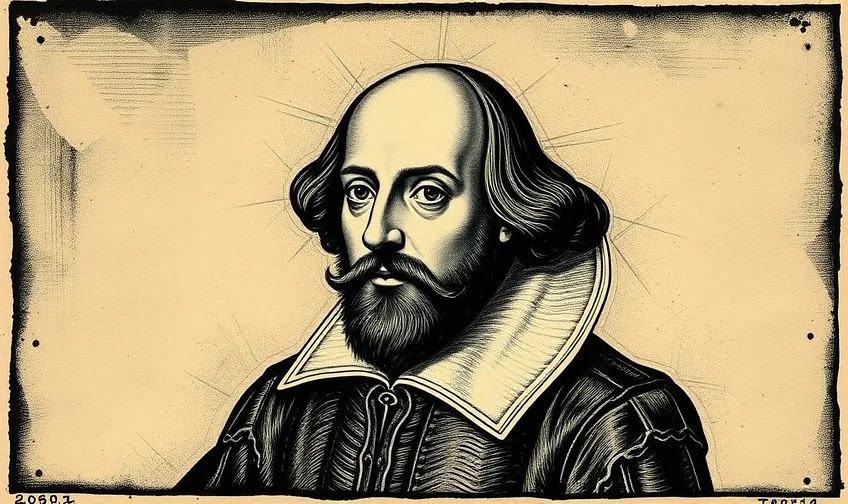
The Shakespeare authorship question was not a topic I had ever taken a special interest in. As a student I simply accepted the conventional view. Over time, however, I realized that a rigorous, evidence-based case for the glover’s son from Stratford-upon-Avon as author of the works in question had never, in fact, been made and that there were strong reasons to believe that the name associated with these works was a pseudonym and was generally understood to be such by those in the know at the time.
One strong reason to doubt that the man from Stratford wrote these very significant works is the complete lack of a literary paper trail generated during his lifetime, documentary sources (letters, official documents, etc.) which attest to his having been a writer. There is plenty of such evidence for other writers of the time, even for relatively minor figures.
Lately I have been having another look at the Shakespeare authorship debate and was surprised how polarized and rancorous it has become. I will, however, refrain from speculating on the causes for this and simply set out my current position as clearly and concisely as I can, touching on some broader implications of the debate.
First of all, it’s worth noting that the literary-academic mainstream position has shifted. It is now generally acknowledged that significant parts of the Shakespearean dramatic corpus were written by other authors. Co-authorship, whether through actual collaboration or through revision or supplementation of plays by other hands, was common practice at the time and the traditional view of there being a single author of the plays in question is simply no longer tenable. The question (for the plays at least) is now one of primary or principal — rather than sole — authorship.
If I were to delve more deeply into the authorship question, my focus would probably be the poems rather than the plays. For one thing, single authorship for poems is the norm, but there are other reasons. Crucially, it was the publication of the narrative poems “Venus and Adonis” (in 1593) and “The Rape of Lucrece” (in 1594) which first brought the name William Shakespeare to public prominence in a literary context: both publications bore a clear authorial designation and were extremely popular. (“Lucrece”, by the way, is a richer and more accomplished work than “Venus and Adonis”; the latter I find forced, artificial and rather tedious — though interesting from a psychological and moral point of view.)
In my view, doubts may be raised about the conventional view that the man from Stratford wrote the Shakespearean oeuvre purely on the basis of his station in life and the style and content of the poems which are clearly the work of someone steeped in classical literature and Renaissance art (especially painting).
There are indications also of an acute political awareness. As I see it, much of the poetry and the best of the plays are the work of a disillusioned insider attuned to and caught up in the tides and currents of national politics rather than that of an upwardly-mobile provincial with very little education.
With respect to politics, it’s well to bear in mind that politics and religion were intimately intertwined at the time and (given the upheavals of the Reformation) necessarily transcended national borders. The years leading up to Queen Elizabeth’s death (and the all-important succession) were fraught with social and religious tensions, fears of invasion and civil war, widespread censorship and ruthless political repression.
As I have come to see it, many seemingly obscure or puzzling passages in Shakespeare’s works can be seen to represent the bubbling up of a potent political subtext which would have been clear to informed contemporary readers or audiences. In repressive and dangerous times, a large degree of obliqueness is required. For example, the ploy of setting stories in other times and places is a time-honoured way for writers to provide a certain amount of cover and space for dealing with hot political topics.
The lack of any solid evidence based on contemporary sources for the traditional authorship theory calls at the very least for a degree of skepticism regarding the standard theory but the sorts of considerations I have mentioned above have led me beyond a mild skepticism to the conviction — still largely intuitive but bolstered by a certain amount of research and reading — that the man from Stratford-upon-Avon authored neither the poems nor the plays attributed to William Shakespeare.
The matter will not be finally settled, of course, until we know more about who did write these works, until such time as compelling cases connecting a particular author — or set of authors — to large parts of the canon are made, with each such case incorporating the latest historical findings as well as rigorous textual and linguistic analysis. Stylometric analysis has been used clumsily or misapplied in the past but (mainly due to its usefulness in the area of counter-terrorism and other forensic applications) the discipline of stylometry has attracted funding and advanced significantly in recent years. Quantitative, corpus-based approaches, used judiciously and in conjunction with traditional forms of philological and stylistic analysis, have already changed the research landscape and will no doubt lead to more progress on the Shakespeare authorship front, if not to definitive conclusions.
In the broad scheme of things, historical authorship questions are of limited interest and importance but the rise and persistence of what certainly was and continues to look very much like a cult surrounding the Stratford man has serious implications for how certain groups and institutions will be perceived and judged. If things play out as I think they will, hard questions would rightly be asked about the state and status of our literary and scholarly institutions.
Bear in mind that English literature was not taught in universities or seen as forming the basis of a distinct scholarly discipline until the late 19th century. And when it was eventually introduced to the universities it battled to gain respect. Obviously it would be quite damning for the literary-academic establishment and for the institutional framework which it has created over the last century or so if these groups and institutions were seen to have embraced, promoted and perpetuated a totally false narrative about the creation of some of the most important literary works of all time.
Worse, this narrative (at least in terms of its core elements) has until now been treated within the literary-academic world as sacrosanct and not to be questioned. How unscientific is that?
Of course, many of today’s literary scholars see their field — and the humanities more generally — not only as not being continuous with science but even as being in direct opposition to science and scientific ways of thinking and seeing the world. This is a profound mistake in my opinion.
Moral, aesthetic and political judgements are crucially important and are not amenable to purely scientific methods of assessment. But civilization is built on a division of labour, and the various professions are trusted to develop and deploy expertise in specific areas and to be a source of reliable knowledge for the broader population. How else can charlatans and their false claims be effectively exposed?
Myths and sacrosanct narratives are not just top-down phenomena, of course, being sustained and nourished by complex social dynamics involving, amongst other things, politics (broadly construed), in-groups and out-groups, pecking orders and personal egos.
I recall to my shame, soon after graduating with an M.A. in English, pompously dismissing the Shakespeare-authorship doubts of a non-literary friend. In effect, I took his comments as an opportunity to assert my (relative) authority and status. A far more productive — and mature — response would have been simply to try to draw him out on what had caused him to reject the traditional story.
[This piece first appeared last month on my Substack site (markenglish.substack.com). You're welcome to visit and, if you care to, to subscribe in order to receive future posts (by email or alternatively on the Substack app) as they appear. Subscriptions are free and it's easy to unsubscribe.]
